
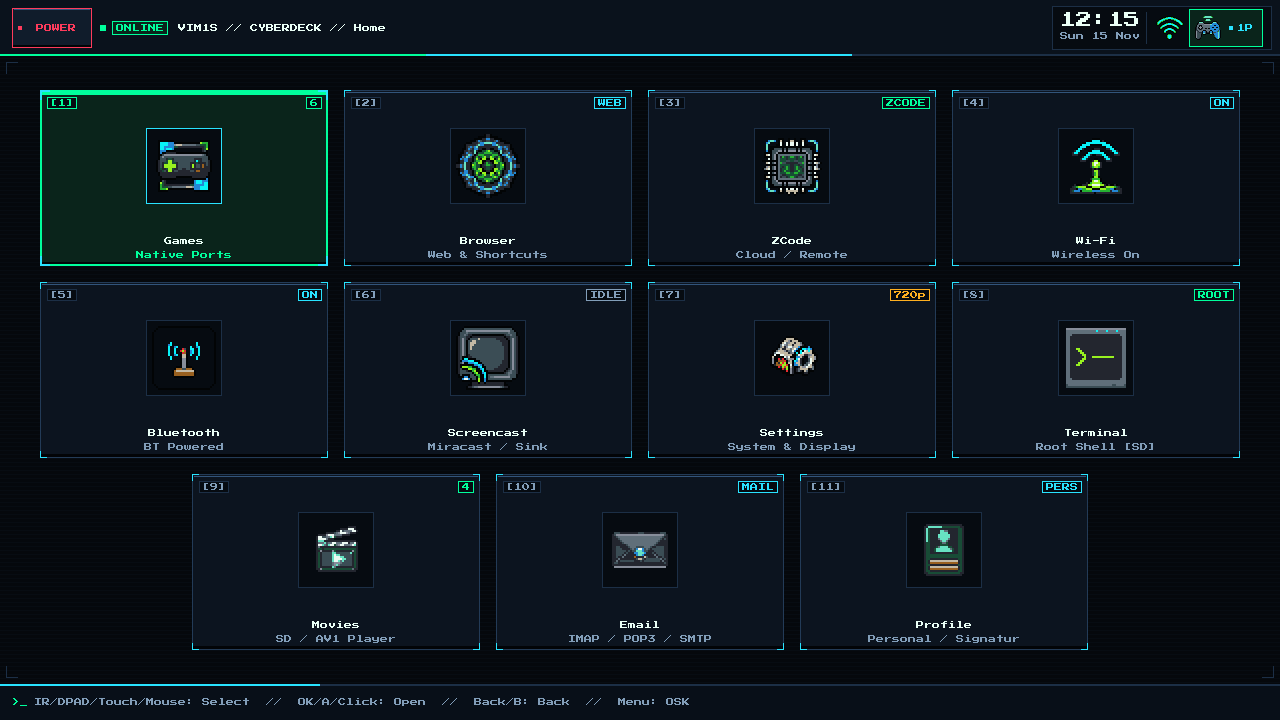
Cyberdeck Console OS — Supported SBC Hardware & Multi-Board Compatibility Matrix
Overview — One Pure-C11 RAM-OS Stack, Multiple ARM64 Boards
Cyberdeck Console OS was engineered around two clean layers:
- A Pure-C11 Wayland / DRM / GLES2 Userland: Custom compositor (
vim1s-compositor), zero-bloat launcher, Pure-ASCII Writer, Retro MIDI Studio, IMAP/OAuth2 Email client, Files, Reader, Music, Terminal, and RAM-sandboxed Firefox ESR. None of these apps hard-code Khadas hardware registers — every screen now runs board-agnostic Cyberdeck branding at 60 FPS using standard Linux DRM/KMS, Panfrost/GLES2, evdev, and ALSA. - A Lean Mainline Linux
7.0.0+AArch64 Kernel (CONFIG_ARCH_MESON=y): Compiled with built-inDRM_MESON,DRM_PANFROST,MMC_MESON_GX,SPI_MESON_SPIFC,MTD_SPI_NOR,SND_MESON_AXG_*,BRCMFMAC,BT_HCIUART_BCM, andRTW88/RTW89USB Wi-Fi drivers.
Because of that separation, boards fall into four clear compatibility tiers below.
CRITICAL FLASH SAFETY WARNING:
Never flashvim1s-spi-ram-os.binonto any board other than Khadas VIM1S! SPI NOR bootchains (BL2/DEVFIP) and Device Tree Blobs (.dtb) are strictly SoC- and board-specific. Flashing the wrong SPI image can brick a board's SPI boot.
Good news: Boards with smaller SPI flash (16 MB or 8 MB) or no SPI flash at all still run the exact same 100% RAM-only OS when booted from microSD or USB — keeping root/intmpfswith zero flash wear during operation.
Tier 1 — Verified & Ready to Flash Today
| Board | SoC & CPU | GPU | Onboard SPI NOR | Built-in Drivers Used | Image Status | Notes |
|---|---|---|---|---|---|---|
| Khadas VIM1S | Amlogic S905Y4 (S4), 4x Cortex-A35 @ 2.0 GHz | Mali-G31 MP2 (Panfrost) | 32 MB | meson-drm, panfrost, brcmfmac (AP6256), hci_uart BT 5.0, aml-vdec AV1 + OP-TEE | Verified Official Build (SPI NOR & USB/SD .img) | Single-chip 9.78 s SPI RAM-OS boot, hardware AV1 decoding, verified HDMI 60/64 Hz & touch/HID. |
Tier 2 — Same-Kernel Amlogic Meson Family (CONFIG_ARCH_MESON=y)
Our shipping Linux 7.0.0+ kernel already enables CONFIG_ARCH_MESON, DRM_MESON, DRM_PANFROST, MMC_MESON_GX, and SND_MESON_AXG_*, and its kernel source tree already carries mainline Device Trees (.dts) for every board below. Bringing up these boards requires swapping only the board U-Boot + .dtb while reusing the exact same Stage-1/Stage-2 ARM64 RAM-OS rootfs (plus per-board Wi-Fi firmware where the wireless chip differs).
| Board | SoC & Family | GPU | SPI NOR Flash | Mainline Kernel DTS Name | Recommended Boot Mode & Effort |
|---|---|---|---|---|---|
| Radxa Zero 2 Pro | Amlogic A311D (G12B, 4x A73 + 2x A53) | Mali-G52 MP4 (Panfrost) | 32 MB | meson-g12b-radxa-zero2.dts | SPI NOR RAM-OS candidate or microSD/eMMC — shares 32 MB SPI capacity + Panfrost + meson-drm. Needs Radxa FIP/U-Boot + DTB + AP6256 Wi-Fi nvram. |
| Khadas VIM3 | Amlogic A311D (G12B, 4x A73 + 2x A53) | Mali-G52 MP4 (Panfrost) | 16 MB | meson-g12b-a311d-khadas-vim3.dts | microSD / USB RAM-OS (16 MB SPI holds U-Boot/FIP only; Stage-1/Stage-2 load cleanly from microSD or USB into RAM). Same Khadas AP6398S Broadcom brcmfmac family. |
| Khadas VIM3L | Amlogic S905D3 (SM1, 4x Cortex-A55) | Mali-G31 MP2 (Panfrost) | 16 MB | meson-sm1-khadas-vim3l.dts | microSD / USB RAM-OS — identical Mali-G31 MP2 GPU pipeline and Khadas ecosystem tooling; swap DEVFIP + DTB. |
| Hardkernel Odroid-C4 | Amlogic S905X3 (SM1, 4x Cortex-A55) | Mali-G31 MP2 (Panfrost) | None (SPI absent) | meson-sm1-odroid-c4.dts | microSD / eMMC RAM-OS — exact same Mali-G31 + meson-drm; Gigabit Ethernet + USB Wi-Fi (rtw88/rtw89 already built-in). |
| Hardkernel Odroid-HC4 | Amlogic S905X3 (SM1, 4x Cortex-A55) | Mali-G31 MP2 (Panfrost) | 16 MB (Petitboot) | meson-sm1-odroid-hc4.dts | microSD / USB / SATA RAM-OS via Petitboot/U-Boot; same meson-drm + panfrost stack. |
| Hardkernel Odroid-N2 / N2+ / N2L | Amlogic S922X (G12B, 4x A73 + 2x A53) | Mali-G52 MP4 (Panfrost) | 8 MB (N2/N2+) | meson-g12b-odroid-n2-plus.dts | microSD / eMMC / USB RAM-OS — very fast hexa-core CPU with mainline meson-drm + Panfrost. |
| Banana Pi BPI-M5 | Amlogic S905X3 (SM1, 4x Cortex-A55) | Mali-G31 MP2 (Panfrost) | None | meson-sm1-bananapi-m5.dts | microSD / eMMC RAM-OS — same Mali-G31 + HDMI DRM display pipeline; Gigabit Ethernet out of the box. |
| Banana Pi BPI-M2 Pro | Amlogic S905X3 (SM1, 4x Cortex-A55) | Mali-G31 MP2 (Panfrost) | None | meson-sm1-bananapi-m2-pro.dts | microSD / eMMC RAM-OS — compact SBC sharing SM1 clock/display/GPU drivers. |
| Banana Pi BPI-M2S / BPI-CM4 | Amlogic A311D / S922X (G12B) | Mali-G52 MP4 (Panfrost) | None (eMMC/SD) | meson-g12b-a311d-bananapi-m2s.dts | microSD / eMMC RAM-OS — compatible kernel drivers; swap bootloader + DTB. |
| Radxa Zero (v1) | Amlogic S905Y2 (G12A, 4x Cortex-A53) | Mali-G31 MP2 (Panfrost) | Optional SPI/eMMC | meson-g12a-radxa-zero.dts | microSD / USB / eMMC RAM-OS — ultra-compact G12A/G31 board with AP6256/AP6212 brcmfmac Wi-Fi. |
| Libre Computer G12B / SM1 Boards | Amlogic A311D / S905D3 | Mali-G52 / Mali-G31 | 16 MB SPI on selected models | meson-sm1-s905d3-libretech-cc.dts | microSD / USB RAM-OS — upstream mainline DTS included. |
| Generic S905Y4 / S905W2 / S905X4 Android Boxes | Amlogic S4 / SC2 | Mali-G31 MP2 (Panfrost) | Rare (usually eMMC only) | Community DTS (s4/sc2) | microSD / USB Multi-Boot — requires unlocked vendor bootloader + matching community .dtb; built-in rtw88/rtw89 helps USB Wi-Fi dongles. |
Tier 3 — Portable ARM64 SBCs (Same Pure-C11 Userland, New Kernel Build)
Because our compositor, launcher, Writer, MIDI Studio, Email client, and Wayland apps depend only on standard Linux DRM/KMS + GBM + EGL/Panfrost/V3D + ALSA + evdev, porting to other ARM64 families only requires swapping the Linux kernel + GPU/KMS driver (defconfig + .dts) while keeping the entire RAM-OS SquashFS/cpio userland intact:
| Board / Family | SoC & Architecture | SPI Flash | Display & GPU Stack | Porting Effort |
|---|---|---|---|---|
| Khadas VIM4 | Amlogic A311D2 (T7, 4x A73 + 4x A53) | 32 MB SPI NOR | amlogic-t7-a311d2-khadas-vim4.dts (Mali-G52) | Medium — newer T7 SoC requires Khadas/T7 video + GPU kernel config additions. |
| Rockchip RK3588 / RK3588S (Radxa ROCK 5B, Orange Pi 5 / 5 Plus) | 4x Cortex-A76 + 4x A55 | 16 MB SPI NOR | rockchipdrm + Panthor (Mali-G610) | Medium — compile Rockchip kernel + Panthor Mesa driver; reuse 100% userland via NVMe/microSD/USB. |
| Rockchip RK3566 / RK3568 (Radxa Zero 3W, Pine64 Quartz64) | 4x Cortex-A55 | Optional 8-16 MB SPI | rockchipdrm + Panfrost (Mali-G52) | Medium — shares identical Mesa Panfrost shader path as Amlogic G31/G52. |
| Raspberry Pi 4 / CM4 / Pi 5 | BCM2711 / BCM2712 (ARM64) | 512 KB - 2 MB EEPROM (bootloader only) | vc4 DRM/KMS + v3d GLES2 | Medium — swap RPi firmware + kernel (vc4 + v3d); boot RAM-OS from microSD, USB, or NVMe. |
| Allwinner H616 / H618 (Orange Pi Zero 2W / Zero 3) | 4x Cortex-A53 | Optional 16 MB SPI | sun4i-drm + Panfrost (Mali-G31) | Medium — reuses identical Mali-G31 Panfrost userland with ARCH_SUNXI kernel. |
Tier 4 — Not Directly Compatible (Different Boot / CPU / GPU Architecture)
- x86_64 PCs / Handhelds (Steam Deck, ASUS ROG Ally, MSI Claw): Different CPU ISA (
x86_64vsaarch64); however, every C11 app (vim1s-writer,vim1s-midi,vim1s-email, etc.) compiles natively onx86_64Linux. - 32-bit
armhfBoards (Raspberry Pi 1/2/Zero W, older Allwinner H3/A20): Requires a full 32-bit rebuild; Firefox ESRaarch64bundle will not execute on 32-bit kernels. - Closed-Bootloader Android TV Sticks / Locked Fire TV Hardware: Signed bootchains reject unsigned Linux kernels without hardware unlock exploits.
What Makes a Board Ideal for Cyberdeck RAM-OS?
64-bit ARMv8 (aarch64)CPU with at least1 GBRAM (2 GB+recommended for smooth Firefox ESR browsing alongside native apps).- Mainline Linux DRM/KMS + Open-Source Mesa GPU Driver (
Panfrost,Panthor, orV3D) — our compositor scans out directly to Linux KMS via EGL/GLES2 with zero X11 bloat. - SPI NOR Flash (
32 MBideal) if you want the entire Linux kernel + RAM-OS inside the board's flash chip (<= 12 scold boot, microSD purely for user saves/documents/games) — or microSD/USB for boards with smaller/no SPI NOR.
Back to Downloads & Setup Guide.